top of page
NatureNova
view best
via
monitor, tab or/and pad
VISIT ME: FACEBOOK / FLCKR / INSTAGRAM
https://www.facebook.com/profile.php?id=100072352597117
https://www.flickr.com/photos/misterdanceswithtrees/
https://www.instagram.com/triffojohn/

HOME

HOME


SOCIOECOLOGICAL
DYNAMIC CONSERVATION
PEREGRINE
APPRECIATION
VENTURE
MOXY

PORTFOLIO
APERÇU

PORTFOLIO
GALLERIES

LEGENDARY
JONATHAN GOOSE


NATURE
MARGINALIA

ECLECTIC HUMANISTIC EUPRAXY
CHICKADEE ETIQUETTE
cold hands & warm hearts

Hand feeding winter birds is much more than just fun and enlivenment · · · it's 'on hands' nature appreciation via stalwart merit on chilly days

not all chickadees will land on a hand

nature never exacts human charity

hand feeding winter birds ~ however ~ is absolutely wonderful for humans to experience · · · ‘first hand’ of course

? ¿ ? where have you been all my life ¿ ? ¿

most chickadees are peaceable with each other

some like to chitchat a wee bit while meeting at the mobile 'grab-and-go' stand-at

some are vociferously chippy and confrontational about who first gets to choose what
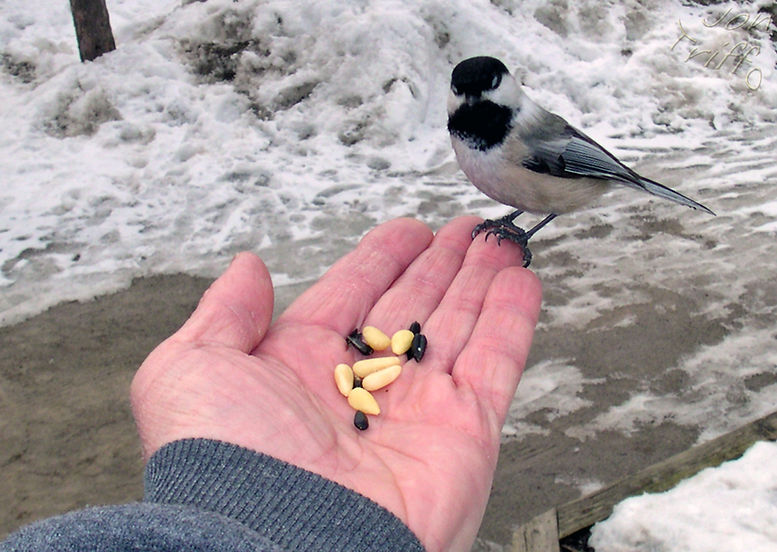
one chickadee surprisingly after many repeated visits for pine nuts landed upon my finger for a wee-mini nap astonishing me 'twixt marvel and anxiety while strrraining to keep myself motionless for almost 2 full sempiternal minutes and managing also a single fascinating photo-clic yet not disturbing it

aspirations of sublime chickadee camaraderie enspirits upright meritoriousness and steadfast good-naturedness

pine nuts mixed with black oil sunflower seeds are excellent for ensuring chickadee patronage during snow season nature hikes . . . especially where localized winter bird feeding is 'anthropogenically' competitive


indiscriminate wildlife feeding is ecologically problematic particularly in urban sprawls and in sensitive habitats vulnerable to inordinate superfluous human intrusion

~~~~~~~~~~ 'little nuthack' ~~~~~~~~~
a new world nuthatch predominantly blue-gray above and rusty-cinnamon below harkens to enthusiastic chickadee calls and finds a veritable smorgasbord of easy pickins'
"LITTLE NUTHACK"
is a rare old name for NUTHATCH species
Sitta canadensis
which currently has a common name
that attracts unwelcome World Wide Web 'cr_wl_r' activity

it's a free-for-all style opportunistic buffet with no bird dare guessing how long it may last

heyyyy
those first-come-first-serve chickadees took all the
pine nuts

alright ... this is better
much much better
now just don't let that ever happen again

'coarse ya realize ya gotta be here every day
with plenty o' pine nuts from now on . . .
an' there's no bein' late

~~~~~~ 'not-so-little nuthack' ~~~~~
a larger new world nuthatch predominantly blue-gray above and white below also harkens to chickadee calls heralding news of food this noticeably larger species of 'nuthack' however is reluctant to land on a hand - often not even for highly coveted pine nuts
"NUTHACK"
is a rare old name for NUTHATCH species
Sitta carolinensis
which currently has a common name
that attracts unwelcome World Wide Web 'cr_wl_r' activity


is quite content sneaking here and peeking there for any uncontested pine nut it may spy
~~~~~~ 'not-so-little nuthack' ~~~~~


downy woodpecker though never truly antagonistically loves upstaging cast and show hamming like a star aglow

so soon as chickadees announce a good find of food opportunistic watchers arrive to watch opportunistically

all day long watchers are watching and watching

as more and more watchers arrive dynamic principles of 'safety-in-numbers ' increasingly favor the many should predators arrive alerted to commotion


cooper's hawk (Astur cooperii) is a classic diurnal predacious 'bird feeder watcher'


racoon (Procyon lotor) is a classic metaturnal/cathemeral omniverous 'bird feeder watcher'
... yup ...
maybe we'll go figure fustian esoteric jargon
on some other page some day
Chickadee Etiquette
When I first began leading Winter Bird Hand-Feeding Tours in Toronto’s Humber River riparian woodland, I quickly realized that competitive local bird-feeding presented a great challenge.
My goal was to lead all of my groups to successful experiences with winter birds coming to feed on at least one human hand. Most of my groups were school children, up to 30 or 60, and sometimes even more. Other groups I led were Girl Guides (Sparks, Brownies, Pathfinders & Guiders), general public special event participants, and outdoor birthday party groups. I often led groups 5 or 6 days a week, and sometimes 2 or even more tours a day.
Many people from the neighboring community were also feeding birds in the area, so some of my hiking tours, disappointingly, had no birds to feed. To remedy this I began studying various bird feeder seeds and feeding techniques that were being used in the area. I also analyzed local winter bird behavior, and I searched for alternative types of bird seed and deployment strategies.
It was my wife, Lizbette, who inspired me to discover the ultimate feeder seed for Chickadees. She introduced me to Pine Nuts (Pinus pinea), and, after munching down a fair number, I found them to be somewhat unsettling and distasteful, in an after-tasteful sort of way, but they intrigued me nonetheless.
I soon found myself learning a lot about Pine Nuts, and I quickly realized that they were likely a perfect dietary supplement for hungry winter birds. They have protein, oil, fiber and calories, and absolutely no husks to husk! Their color and appearance are distinctively contrasting to Sunflower Seeds, and they’re also ideal in shape and size for the task at hand, so to speak. The only negative thing about Pine Nuts is their cost, which is considerably much more than bulk variety bird seed.
For Pine Nut information relating to human nutrition, after taste and anaphylaxis, click the following links:
http://en.wikipedia.org/wiki/Pine_nut
http://www.immunocapinvitrosight.com/dia_templates/ImmunoCAP/Allergen____28354.aspx
After searching for all and any negative information regarding the use of Pine Nuts for bird seed, and having found none, I gave them a try with almost instant great success. Many Chickadees were reluctant to try the ‘nuts’ at first, so I mixed them with more familiar Sunflower Seeds to keep perplexed birds from giving up on me. This was when things got very interesting indeed.
After nabbing Sunflower Seeds and working feverishly to husk out their tiny rewards of good stuff, the Chickadees began to pause at length, once back on my hand, to check out the tantalizing Pine Nuts. Once tried, the new goodies proved to be irresistible to the intense little birds. Having eaten its first Pine Nut, each Chickadee zipped back to my hand and looked me astonished in the face as if to demand, “Where have you been all my life!?!”
Since that day, I’ve been mixing Sunflower seeds with Pine Nuts for winter birds. Every now and then new birds show up and the whole ‘tried-and-true’ versus ‘something new’ thing starts all over again. It’s great!
One day a new Chickadee seemed unfamiliar even with Sunflower Seeds. It was bedazzled by all the activity at my hand as 'S.c.' Nuthatches (Sitta canadensis), Downy Woodpeckers, and other Chickadees were zipping back and forth with glee for seeds. I put a mix out on a stump for the new arrival to peruse, but it only leered quizzically. Thinking quickly ‘on my toes’, I searched around a bit and found some Maple Keys to add to my otherwise exotic mix on the post. The new Chickadee now saw something it could clearly relate to, and then one seed led to another . . . and before long, it was impossible, and ostensibly nugatory, to determine if the new bird ever did land on my hand or not.
Sometimes, a Chickadee new to Pine Nuts tries to have it both ways, even on the hand of a child. This is why I recommend extending seed loaded palms straight out in front of one’s self, so that all of the wonderful action can be easily viewed.
Exceedingly curious and highly opportunistic, some Chickadees will try to take away both a Sunflower Seed and a Pine Nut in one foray. With first a Sunflower seed in beak, the birds will try to secure also a larger Pine Nut, but they have to open their beaks so wide that the Sunflower seed falls out. When they try with first a Pine Nut, they are unable to clamp down enough to hold, or even to acquire, a Sunflower Seed. It’s all quite priceless to behold ... and it tickles fingers too!
Occasionally, some Chickadees managed to scoop away 2 Pine Nuts in their beaks. One Chickadee in particular attempted from time to time to fly off with 3 Pine Nuts in its beak. Reportedly, from irreproachable reports of elated young observers, the 'Three-Nut Chickadee' was successful on more than just one occasion.
Other notable individual wonder-birds included 2 Chickadees that would sit on my hand and noisily bicker about who should be allowed to first take a seed. Conversely, there were also 2 individuals who would wait for each other on my hand and then one would pick up a Pine Nut, politely pass it to the beak of the other, and then pick up one for itself, and then both would fly off in different directions.
Another interesting individual seemed to like warming its feet on my hand. It actually took a brief 'bird nap' while perched on my finger once. Holding my hand out very still so as not to wake it was extremely excruciating after a while, especially as I fumbled with a small digital camera to get the above top-page picture #2 of it.
Now, to successfully compete with all the other bird feeders in the area, I diligently kept a pole mounted bird feeder stocked with various feeder seeds mixed with a few Pine Nuts. I had to devise squirrel proof protection for the feeder, as all the local squirrels soon became ingeniously desperate for Pine Nuts. Once all the birds in the area were secure with a reliable daily food source, they had little incentive to forage or venture much afar.
A day or so prior to leading a group for winter bird hand feeding, I'd stop mixing Pine Nuts into the bird feeder mix.
Hand feeding was usually done down a trail at a place I named Chickadee Corner, or near a Beech Tree I named Ant-o’-Lantern Tree.
(See: Ant-o’-Lantern Tree)
Normally, at the beginning of each tour, I demonstrably instructed Chickadee Etiquette for tour participants. I then made sure that our hike down to Chickadee Corner was full of boisterous fun with lots of laughter and giggles. If the group was quiet, which was perfectly good as well, I interpreted nature along the trail while speaking loud and clear for all to hear. Either way, the hike was always zigzaggy enough, and loud enough, to advertise to all the birds that lots of Pine Nuts were soon to be served.
Quite often in my preliminary Chickadee Etiquette session, I was able to introduce a 'concept' of Crepuscular Zugenruhe relating to heightened feeding activity among winter birds at dusk and at dawn. Zugenruhe is a birders’ term (perhaps even an ornithologists’ term) for pre-departure excitation observed in staging avian migrants.
I use the term combined with ‘crepuscular’ to help describe intensified feeding behavior exhibited by birds faced with survival during long, frigid winter nights. They accumulate as much energy reserve as they can before nightfall, and they replenish as much energy reserve as they can at dawn.
When very young children participated in hikes to Chickadee Corner, I tried to get them to sing my ‘Zugenruhe Song’, since Zugenruhe is such a fun ‘big’ word for kids to learn anyway. The song is actually a simple marching chant I spontaneously came up with one day. It goes like this:
Zoo – gen – roo!
Zoo – gen – roo!
Chickadee! Chickadee! Zoo – gen – roo!
When children sang this the Chickadees usually arrived for Pine Nuts well before our arrival at Chickadee Corner or at Ant-O’-Lantern Tree.
Before long, my Winter Bird Hand-Feeding Tours were operating at an almost 100% success rate in getting birds on hands. In my best winter, only 2 tours failed to get birds on hands, but none failed to get any birds at all.
One of the ‘failed’ tours, however, was most surprising and memorable. After exploring the amazing ‘Ant-O’-Lantern Tree’ for as long and as loud as I could, and after telling the story of the mysterious ‘Ant House’ at Chickadee Corner for as long and as loud as I could, our group was dismayed at an absolute absence of Chickadees and other winter birds.
As we began to plod onward along the river side, I mentioned that perhaps a hawk or owl had been by and had scared all the birds away. At that moment, a small group of Chickadees appeared in the branches high above us. As we frantically reached for our bird seeds and held out our hands, the Chickadees started to take notice and flutter near. Suddenly however, one Chickadee blurted an alarm call and flew to a tree top to call repeatedly more. Then all the Chickadees flew up to tree tops and began scolding in alarm. Before we knew it, a young female Cooper’s Hawk (Accipiter cooperii) flew up in full view before us and started to race away. Without hesitation, the Chickadees all also raced away in close, raucous pursuit of the hawk, delivering grief and anguish more than it could bear. The accipiter charged across the river, out of the parkland, and probably well into Mississauga while dodging and darting in vain attempts to rid itself of its tenacious pursuers.
As we all looked about at each other in astonishment, I matter-of-factly eventually commented, “Another thing about Chickadees . . . never get them mad at you.”
~~~~~~~~~~~~~~~~~~~~~~~~~~~~~~~~~~~~~~~~~~~~~~~~~~~~
Chickadee Etiquette: Basic Considerations
• Chickadees don’t mind casual sounds and noises, such as talking and fidgeting with bags of bird seeds, but they do become alarmed at loud, abrupt noises such as shouting, clapping, and banging sticks and things.
• Chickadees will sometimes briefly investigate ‘birder pishing’, but if bird seed isn’t yet in outstretched hands, they may quickly flutter away and not bother coming back. Pishing is not recommended as Chickadees often seem too disinterested in feeding when they investigate such sound. Also, repeated pishing tends to annoy birds that have already once responded.
• Chickadees seem to be annoyed by human attempts to mimic animal sounds, and by attempts to command them to be obedient as if they were puppies, or to summon them like pampered house cats.
Chickadees also seem to be annoyed by whistling.
It is possible to ‘habituate’ local Chickadees to various stimuli that might otherwise annoy them. This can be achieved by routinely introducing and subjecting them to the stimuli while they are actively feeding, but such practice might likely alienate less familiar, new arrivals.
About Winter Bird Behavior
• Cold weather causes small birds to exhibit ‘crepuscular zugenruhe’: a mini type of zugenruhe more related to avian photoperiodic energetics as opposed to migratory pre-flight diurnal restlessness. Small birds often feed more intensely prior to nightfall, to build up enough energy reserves to survive cold nights, and then again during sunrise, to quickly replenish energy reserves that have been depleted in frigid darkness.
In an example of this, I was photographing Ruby-crowned and Golden-crowned Kinglets one frosty evening, and my telescopic lens was soon unable to focus close enough to continue at one point. One Kinglet briefly hopped onto the toe of my shoe as it scampered along the ground between flutters to and from low shrubby branches. The birds were feeding far too frenetically to worry about human presence.
• When Chickadees arrive for feeding from human hands, or from ant other sort of platforms or stations, other species are very likely to arrive and, if nothing else, exhibit keen notice.
• Local groups of Chickadees can readily adapt their daily routines to be on time for regular feedings. (In fact, once a feeding routine has been established, they seem to boss and perhaps even scold their providers for being late and tardy.)
• Chickadees often spy danger in advance, and are usually first to voice alarm . . . lead a charge of raucous, mobbing protest . . . and even give pursuit to predators choosing to flee intense aggravation.
Optimal Winter Bird Hand Feeding Group Experience
• Busy bird feeder areas work extremely well if the local birds become accustomed to regular Pine Nut supplementation. Simply prime the feeder regularly with Pine Nuts in the feed, then hold back the Pine Nuts a day or so prior to a group visit.
• Find a bird-busy location that is sheltered from cold wind, yet fairly open with sparse trees and shrubbery that are conveniently accessible to hungry winter birds.
Prime the ideal location with Pine Nuts mixed into bird seed for a week or so. Try wearing the same apparel and getting the birds used to hearing your voice while hand feeding them.
• Invite friends and guests and groups to hand feed winter birds with you as often as you can.
• Demonstrate and encourage earnest hand feeding with palms held straight out and forward. Chickadees can learn quickly to assess safest and most reliable 'hands'.
• Children can practice hand feeding by pretending to be statues with good posture while holding their hands straight out, flat and motionless in front of themselves . Children are also challenged to earn Chickadee 'visitorship' by being patient, trustworthy, and sensitive to Chickadee sensitiveness. (Parents and teachers usually love all this.)
~~~~~~~~~~~~~~~~~~~~~~~~~~~~~~~~~~~~~~~~~~~~~~~~~~~~~~~
Other Species to watch for
near Bird Feeders in Humber River 'RIPARIA'
Dark-eyed Junco (Junco hyemalis)
- surprisingly bold at times, yet very difficult to
entice to hand
Northern Cardinal (Cardinalis cardinalis)
- surprisingly shy and exasperatingly difficult to entice to hand, yet highly covetous as well
Mourning Dove (Zenaida macroura)
- quite covetous at times, though seemingly aloof and difficult to entice to hand
House Finch (Carpodacus mexicanus)
- highly disruptive and domineering at the feeder
and never interested in coming to hand
White-throated Sparrow (Zonotrichia albicollis)
- highly minimalistic self-sufficient foragers with no interest in coming to hand
Song Sparrow (Melospiza melodia)
- occasional visitor, highly self-sufficient, yet curious, but never interested in coming to hand
Fox Sparrow (Passerella iliaca)
- rare visitor, shy, elusive, self-sufficient, and never interested in coming to hand
Hairy Woodpecker (Leuconotopicus villosus)
- occasional visitor, sometimes curious, yet quite aloof and uninterested in coming to hand
Ring-necked Pheasant (Phasianus colchicus)
- introduced game bird - extremely wary and only approaches feeder area when convinced no humans or potential predators are present
Eastern Gray Squirrel & 'Eastern Black Squirrel'
(Sciurus carolinensis)
- extremely domineering, disruptive, problematic, aggressive and very difficult to keep out of the feeder
Eastern Cottontail (Sylvilagus floridanus)
- often crepuscular, unassuming, quite shy and innocuous near the feeder
White-tailed Deer (Odocoileus virginianus)
- crepuscular and nocturnal woody browser & seed muncher
Raccoon (Procyon lotor)
- occasional nocturnal raider, practically impossible to keep out of feeders
Eastern Meadow Vole (Microtus pennsylvanicus)
- nocturnal woody browser & seed muncher, occasionally seen in daylight
Eastern Deer Mouse (Peromyscus maniculatus)
- nocturnal scrounger & seed muncher, occasionally seen in daylight
Great Horned Owl (Bubo virginianus)
- locally residing nocturnal hunter and daytime rooster, highly motivated to hunt rabbits and mice at night
Long-eared Owl (Asio otus)
- locally residing daytime rooster and nocturnal hunter of small rodents
Northern Saw-whet Owl (Aegolius acadicus)
- rare locally residing daytime rooster and nocturnal hunter of small rodents
Red-tailed Hawk (Buteo jamaicensis)
- common daytime hunter of squirrels and larger birds
Cooper's Hawk (Astur cooperii)
- occasional daytime hunter of small birds
Sharp-shinned Hawk (Accipiter striatus)
- rare daytime hunter of small birds
American Kestrel (Falco sparverius)
- occasional daytime hunter of small birds and rodents.
~
Chickadee Etiquette
photos and text
Original Version Copyright © John (Jon) Triffo 2006
Revised and Updated Version Copyright © John (Jon) Triffo 2026
~
bottom of page